
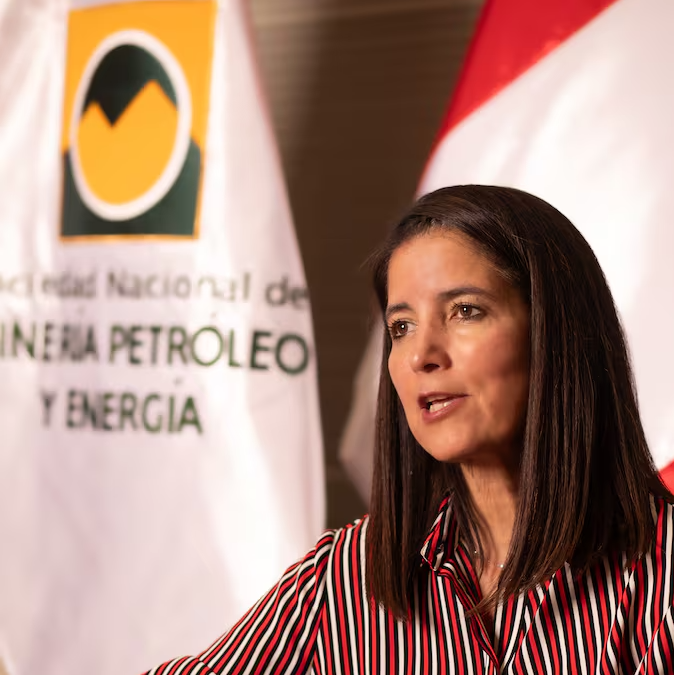
(16-07-2025) The President of the National Society of Mining, Petroleum and Energy (SNMPE), Julia Torreblanca, welcomed the position of the Energy and Mines Commission of the Peruvian Congress, which rejected the draft bill of the MAPE Law, and expressed her hope that the new Commission in the next legislative session, “free of conflicts of interest,” will be able to renew the regulation “without political or electoral motivations,” she stated in an interview with Radio Nacional.
She emphasized the importance of shared responsibility, adding that “the new MAPE Law could change the history of Peru, by enforcing regulations and protecting people”. She stated that the law must establish and define the obligations not only of artisanal miners but also of small-scale mining, as well as the responsibilities of national authorities.
In this way, it would be clear who is responsible for monitoring and supervising the environmental impact, ensuring that those who work in mining do so with the necessary protective equipment, and preventing unfortunate accidents.
The executive also stressed the importance of the State’s continued work to provide clear information that encourages the formalization of miners. However, she emphasized that it must be made clear that mining activities cannot take place in archaeological sites, indigenous territories, or unauthorized zones, and that road blockades should not be allowed and the law must be enforced.
Last March, Máximo Gallo, Director of the Mining Formalization Directorate at the Ministry of Energy and Mines, stated that he hoped to formalize between 3,000 and 5,000 miners by midyear, and to reach a goal of 25,000 by the end of the year, provided that Congress approves the MAPE Law.