

(21-05-2025) Mining production performance during Q1 2025 showed mixed results compared to the same period in 2024, with increases in molybdenum (13%), silver (10.8%), copper (3.9%), lead (2.6%), and zinc (0.8%), and contractions in gold (-10.8%), iron, and tin (-0.8% each), according to the Mining Statistical Bulletin published monthly by the Ministry of Energy and Mines.(Table 1)
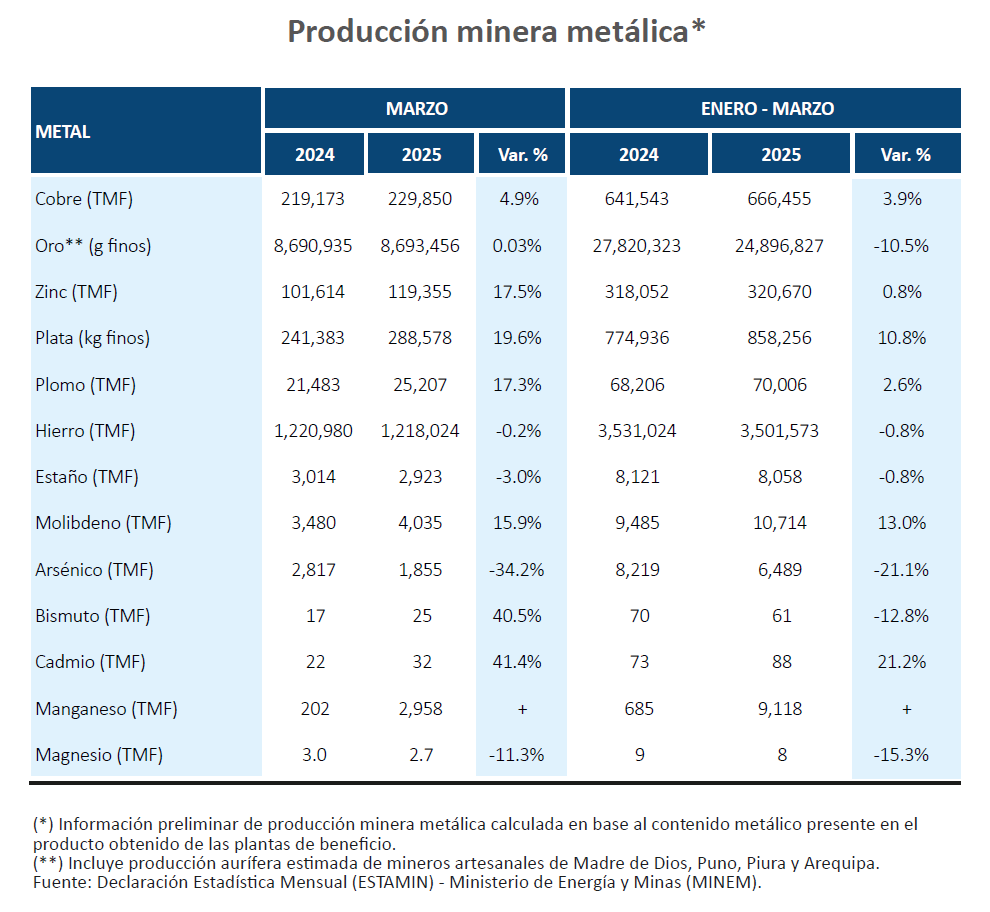
Peru produced 666,455 FMT of copper during Q1 2025, a 3.9% increase compared to the same period the previous year (641,543 FMT). The leader was Southern Peru Copper Corporation with 105,094 FMT, almost the same level as Q1 2024 (105,054 FMT), holding a 15.8% share. It was followed by Sociedad Minera Cerro Verde S.A.A., which decreased by 7% to 100,147 FMT versus 107,694 FMT the previous year, with a 15% share. In third place, close behind, was Compañía Minera Antamina S.A., with 97,774 FMT, also a 7.6% drop.(Table 2)
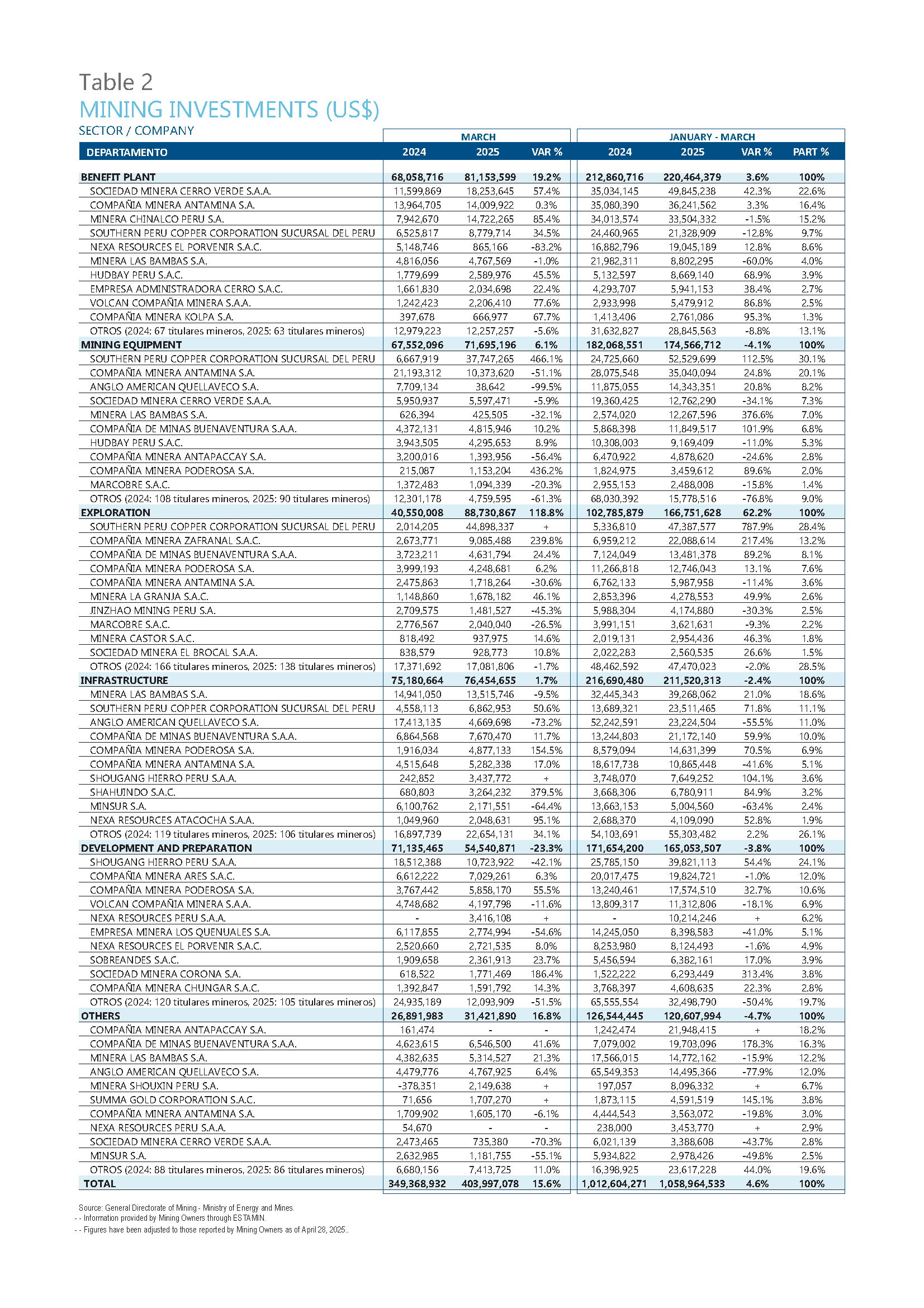
The reductions in production from these two major mining companies were offset by growth from Minera Las Bambas due to increased ore processing (70.9%), Minera Chinalco (36.5%), and Anglo American Quellaveco (11.9%).
Moquegua, Arequipa, and Áncash together accounted for nearly 50% of Peru’s copper production (48.5%), with Moquegua leading at 18.3%, followed by Arequipa (15.1%) and Áncash (15%).
The nearly 25 FMT of gold produced during the analyzed period were not enough to reverse the 10.5% contraction compared to the 27.8 FMT recorded in Q1 2024. This was despite a 15.6% increase to 3.26 FMT from the emblematic Minera Yanacocha, the top gold producer in both Peru and South America, contributing 13.1% of total output. Other companies showed declines, in order: Cía. Minera Poderosa (-4.8%) with 2.19 FMT; Consorcio Minero Horizonte (-8.3%) with 1.43 FMT; Minera Aurífera Retamas (-5.3%) with 1.31 FMT; Minera Boroo Misquichilca (-39.6%) with 1.3 FMT; and Compañía Minera Ares (-5.2%) with 1.1 FMT.
Yanacocha regained its leading position thanks to the installation of the “Gold Mill” plant, which processes transitional minerals that can’t be placed in leaching pads (for oxides) due to their sulfur content.
Aside from Yanacocha, only Paltarumi (33.3%) and Gold Fields La Cima (34.6%) showed production increases among the top 10 producers.
Conversely, national silver production rose by 10.8% to 858,256 FKg, led by Cía. Minera Antamina with 106,205 FKg and a 38.7% increase, followed by Cía. de Minas Buenaventura with 99,283 FKg and an impressive 159.7% increase. The Peruvian company launched its new mining unit “Acumulación Yumpag” in the Pasco region and focused on optimizing operations at its existing Uchucchacua mine in the Lima region, while also increasing production of other metals like zinc, which in turn boosts silver output.
Other companies that increased silver production included Volcan Cía Minera (15.2% to 51,766 FKg), Minera Las Bambas (29.8% to 33,265 FKg), Marcobre (51.1% to 31,931 FKg), and SobreAndes (16.2% to 30,801 FKg).
Peru is the second-largest world silver producer after Mexico.
As for zinc, production performance was mostly stable, with a slight increase of 0.8%, totaling 320,670 FMT. Cía. Minera Antamina led by far with 103,589 FMT and 32.2% growth, followed by Volcan Cía. Minera with 40,399 FMT and 15.8% growth. Together, these two companies accounted for 45% of national zinc output.
However, declines from other major producers, such as Nexa Resources Perú in third place (down 29.3% to 18,502 MT) and Minera Shouxin in sixth place (-48.6% to 12,302 FMT), offset the gains from leading companies.