
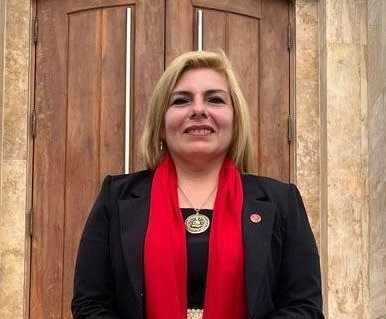
An interview with Eng. Sandra Melissa Ramírez Arias, President of the Geological Engineering Chapter of the Peruvian College of Engineers.
- What motivated you to assume the presidency of the Geological Engineering Chapter of the Peruvian College of Engineers?
I have always believed that geologists play a fundamental role in the sustainable development of the country. Taking on this position was an opportunity to strengthen the voice of our professional community and promote a geology that is closer to society. - What have been the main challenges and achievements of your administration so far?
The greatest challenge has been bringing together a diverse and dispersed professional community. Among the achievements, I would highlight the promotion of technical training, regulatory updates, and the increased visibility of the geologist’s role in environmental and natural hazard issues. - What role does geology play in Peru’s development today?
It is a cornerstone. From mineral exploration to water management and disaster prevention, geology provides essential knowledge for decision-making. Without geology, there is no territorial planning and no safe development. - In a so vulnerable country to natural disasters, what challenges do we face in managing geological risk?
The main challenge is integrating geological science into urban planning and public policy. Sometimes decisions are made without considering the geological foundation of the territory, and that costs us lives and infrastructure. - How do you assess the training and professional development of geologists in Peru?
We have very good schools, but gaps remain. We must incorporate more technology, geospatial modeling, and artificial intelligence into training. From the chapter, we promote workshops, diploma programs, and partnerships with universities. - What role do geologists play in the transition toward more sustainable mining?
A central one. Geologists can anticipate impacts, assess risks, and propose solutions for the responsible use of resources. Sustainability begins with understanding the territory. - How does the chapter coordinate its work with institutions such as INGEMMET or the Ministry of Energy and Mines (MINEM)?We work together on technical, regulatory, and training matters. Our shared goal is to strengthen professional practice and ensure that national decisions are grounded in geoscientific knowledge.
- In a field still largely male-dominated, what progress do you see in the participation of women geologists?
There are more of us every year, and with more leadership. But cultural barriers still exist. From the chapter, we aim to highlight the work of women geologists and promote equal opportunities. - What goals have you set for the coming years?
To consolidate a national network of active registered geologists, strengthen continuous training, and position the chapter as a technical reference in public policy and sustainability. - Finally, what message would you leave for young geologists?
Never lose your curiosity or your commitment to the country. Geology is not just the study of rocks; it is the study of the relationship between humans and the land they inhabit.