
(16-07-2025) Companies demand more professionals with technical degrees than university degrees. Therefore, it is necessary to change certain biases that families have regarding higher education, stated Alexandra Ames, Executive Director of the National Scholarship Program, PRONABEC.
Ames emphasized that access to higher and technical-productive education is insufficient, inequitable, uncoordinated, and poorly aligned with labor market needs.
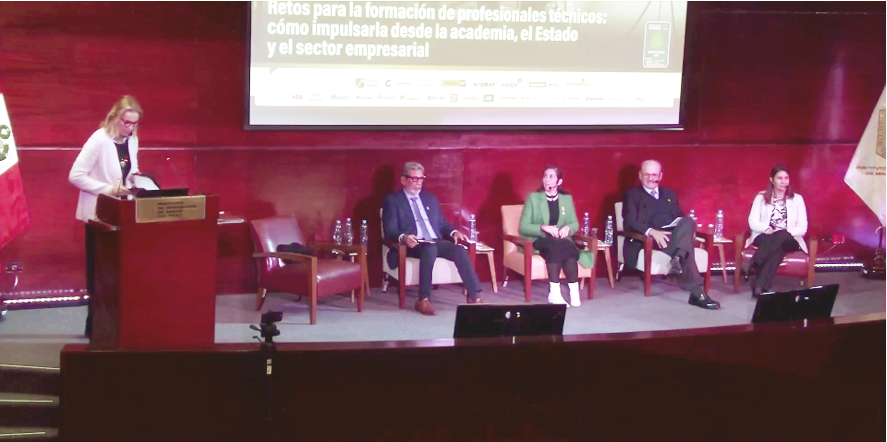
This was discussed during the Jueves Minero (Mining Thursday) conference held on July 10, organized weekly by the Institute of Mining Engineers of Peru (IIMP), under the title: “Challenges in training technical professionals: How to promote it from academia, the state, and the business sector”.
Based on the Occupational Demand Survey (EDO), more than 60% of new job positions in the Peruvian labor market for higher education graduates currently require technical profiles. “This reveals a mismatch between higher education enrollment and the demand for workers in the labor market. These trends are not necessarily aligned with what companies or national productive development strategies require”.
Similarly, the employability rate of technical program graduates is higher compared to that of university graduates. “Wages for those who go through technological-technical-productive higher education are often higher than those earned by graduates from some universities in the country”.
The senior official announced that PRONABEC will provide 20,000 full scholarships for public and private higher education and 5,000 scholarships for technical careers in 2026 through Beca 18 and Beca Tec. These scholarships will cover academic and non-academic expenses such as enrollment fees, tuition, study materials, clothing and/or uniforms, meals, and local transportation. “Beca Tec aims to encourage families to break down existing biases or undervaluation of technical careers. We’re starting with 300 scholarships this year, increasing to 5,000 next year, and we hope to continue scaling up”.
Promoted by the government, Beca Tec includes a stipend similar to the minimum wage and was developed to encourage job placement in high-demand fields in Peru such as geology and exploration technician, mechanics and metallurgy, automotive mechanics, logistics management, electronics, automation, among others.
Additionally, it seeks to expand students’ practical skills for earlier participation in the workforce. Ames also highlighted the importance of developing soft skills in technical education, especially for those who will work in the mining sector and must interact with the communities where operations take place.
Beca Tec targets individuals between 17 and 39 years old who have completed high school in regular or alternative basic education, and wish to pursue in-person studies in technological or technical-productive higher education.
Applications are open from July 21 to September 15, and the list of selected candidates will be published on October 13. More information is available at: https://bit.ly/460zfnR
Panel
The panel featured Raúl Benavides, Chairman of the Board of CETEMIN; José Luis Naranjo, Chair of the Labor Commission of the National Society of Industries; and Letty Ojeda, Vice President of Human Resources at Minera Las Bambas. The discussion was moderated by Diana Rake, IIMP Board Director and CEO of Diana Rake & Associates.
In line with the conference, Rake stated that the development of mining not only depends on extraction but also on properly trained professionals. Meanwhile, José Luis Naranjo emphasized the urgent need to support youth through education. He stressed that PRONABEC’s Beca Tec, by financing technical training, should become a state policy rather than one dependent on the current government.
On the other hand, Raúl Benavides pointed out that technical institutes must train students in the skills required by the industry, not just those desired by instructors. He called for the use of 21st-century technologies such as Artificial Intelligence (AI). He affirmed that technical education is an opportunity, offers advantages over university education, and is the fastest way to secure employment.
Letty Ojeda, for her part, stated that in rural areas, only 20% of high school graduates choose technical education, and highlighted that technical training is a strategic need for the mining sector.