
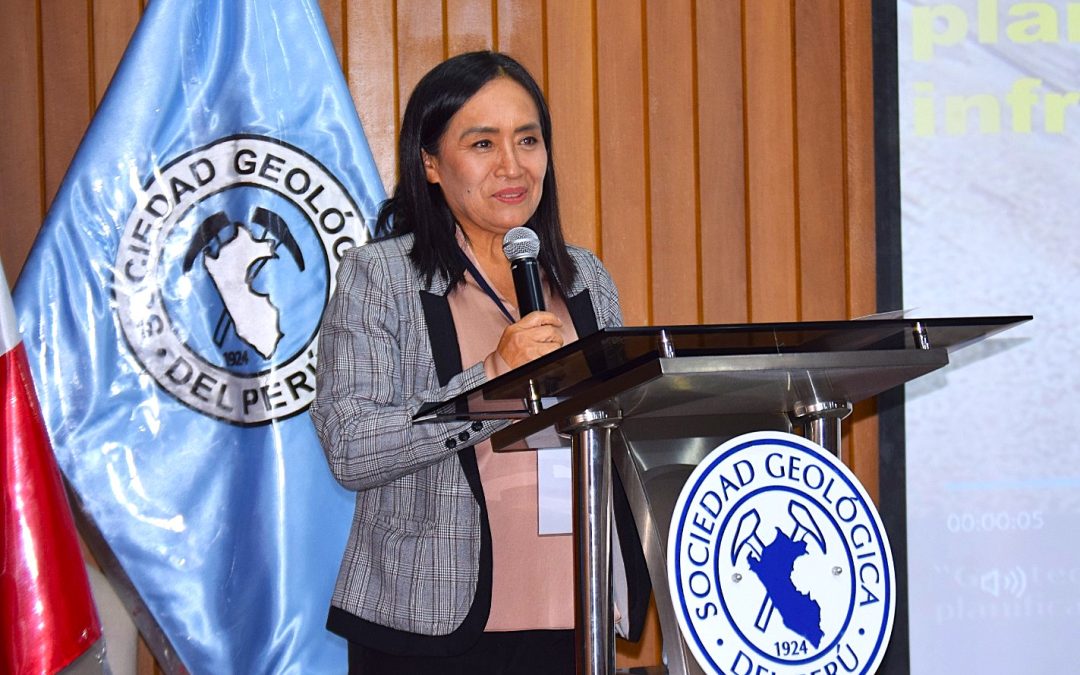
(12-06-2025) Natural phenomena that are increasingly frequent and devastating, are problems our society faces. “It is us who have settled improperly”. These were presented and discussed in 18 papers, 6 keynote lectures, and 3 forums at the III Symposium on Geotechnics and Hydrogeology – GEOTHIDRO‑2025, organized by the Geological Society of Peru, from June 4 to 6.
This was emphasized by Engineer Gloria Fernández, President of GEOTHIDRO 2025, during her remarks, at the closing ceremony, which we reproduce in this article.
The event, under the theme “Geotechnics and Hydrogeology: New Perspectives in 21st-Century Infrastructure Planning,” also heard serious proposals to meet these challenges and secure the infrastructure our country needs.
Three interrelated focus areas: Geotechnics, Hydrogeology, and Disaster-Risk Management
 Civil infrastructure needs to be designed taking each of these factors into account. Ignoring them leads to outcomes we’ve seen before: “collapsed structures, inaugurated three times with the same mistakes in the same place”. As geotechnical engineer Ralph Peck said, “Geotechnics is the art of turning mistakes into experience”, but in many cases we keep repeating the same error—translating them into millions in financial losses and, tragically, loss of human lives. That should be a wake-up call for all technical professionals.
Clearly, there is also a lack of education, dissemination, and planning. A lack of opportunity –our vulnerable populations buried in poverty– and a lack of planning has led to chaotic urban growth. Let’s be honest: what options does a poor person living where there is no road or where bridges collapse have? They can’t transport their products. The list of shortages and lack of services for remote communities is endless. Most importantly, none of what we’ve mentioned reaches those who govern us. That is deeply concerning because we’re leaving our future in the hands of those who are supposed to serve us—not lead us.
Geotechnics.- In this event, we heard solutions for large-scale mine stability and even for small sillar quarries in Arequipa, where workers learned through practice and were later validated by specialists. Recently there was a tragic mining road accident. Regardless of legal responsibilities, I’m almost certain no one analyzed the pavement of that mineral haulage road. As we learned in this symposium, there is no technical data, no training, and very few specialists paying adequate attention.
Connectivity and Infrastructure.- A country interconnected by quality roads is on the path to development—and we lack this. A railway network could spark economic leaps, just as the Chancay port is doing. Plans exist, and we hope their implementation begins soon. Geotechnical engineers, hydrogeologists, and risk managers, there is much work to do and contributions to make.
Disaster-Risk Management.- While we’ve made progress in disaster-risk management, much remains to be done. Apparently, those in power don’t understand the economic and social scale of these issues. We see institutions being created more as reactions to catastrophic events—shifting from one agency to another—like orphans without parents, and politicians lurking in emergencies. In this Symposium, we hope to bring more disaster-risk managers to present serious technical arguments to decision-makers.
Hydrogeology.- We have heard how new technologies—geophysics and isotope analysis—help during exploration to prevent contamination, act in time, and avoid misplaced blame. Hydrogeology plays a vital role in mitigation and remediation through new technologies such as permeable reactive barriers, nanomaterials, electrokinetic techniques, and in‑situ remediation with advanced oxidants. Nevertheless, despite all these advances, many technical, institutional, and social challenges remain. The hydrogeologist must act as a bridge between science, technology, and environmental management.
In the Water Forum, we learned that Sedapal has managed to stabilize the groundwater table in our basin, that treated wastewater is now being reused, and yes, this will lead to an update in water tariffs next year.
The insights shared at this Symposium are crucial for our country, as we continuously face natural hazards. This event gave us the opportunity to learn, improve, and find effective solutions.
Acknowledgments
Engineer Fernández thanked the Geological Society of Peru for entrusting her with the leadership of GEOTHIDRO again, and she recognized her team, sponsors, technology exhibitors, allied institutions, media partners, participants, and especially the experts who generously shared their knowledge and experience.
She also urged the upcoming SGP board—and future ones—to involve political decision‑makers in future events, to educate them and present conclusions directly to them and thus make them responsible for outcomes. “No more collapsed bridges, please”.