

(01-07-2024) With a record of 1200 participants compared to previous editions, the XV National Mining Congress (CONAMIN) took place from June 24 to 28 in the city of Trujillo, being considered the best CONAMIN held so far.
Organized by the Mining Engineering Chapter of the Lima Departmental Council of the College of Engineers of Peru, and under the presidency of Eng. Edgardo Orderique, 150 technical papers, 7 specialized forums, 12 keynote lectures, 4 special conferences, 3 round tables, and a Business Meeting were presented, with 90 speakers and more than 200 suppliers at the MAQ-EMIN fair.
Eng. Orderique highlighted the importance of working with true artisanal miners to formalize them and integrate them into modern mining, and the industry’s fight against illegal mining. He made a strong call to close the REINFO and respect the deadlines set for the formalization process. He added that this should be accompanied by strengthening regional governments and other specialized institutions such as SUCAMEC (National Superintendence of Control of Security Services, Weapons, Ammunition, and Explosives for Civil Use), the financial intelligence unit, and SUNAT (taxes agency).
He also welcomed the progress of the single digital window, as well as the supreme decree issued on June 27, which expands the processing capacity of mines by up to 10% without the need for additional permits.
However, he emphasized that work must continue to speed up explorations, considering that “25% of rejected permits are on the side of the investor and 44% have obtained authorization but have not started drilling. So, to be fair, this 44% should be excluded from this statistic as explorations are not carried out; for various reasons, they acquire these permits but do not carry out the drilling.”
For the industry to continue growing, “it requires that environmental permits be obtained in less than 1 year,” approximately the time it took around 2010. Therefore, he welcomed the actions announced by the Minister of the Environment to comply with the times specified in the regulations.
As decarbonization and energy transition were central themes of the XV CONAMIN, Eng. Orderique highlighted the significant advances in the use of renewable energy, efficient water use, carbon footprint measurement, and the establishment of 2030 as the baseline year for reducing and capturing 43% of greenhouse gases, in line with the Paris Agreement, and meeting 60% by 2035 and 100% by 2050.
In this regard, he cited the “Water Virtuous Circle” presented by Dr. Julia Torreblanca of Sociedad Minera Cerro Verde as an example of what the mining industry can achieve in collaboration with authorities and for the benefit of citizens. This is a case that “not only has a socially positive impact on the Arequipa community, but it is also a clear example of what Circular Economy means: treating wastewater, using the waste from that water, and we’re seeing a very clear Circular Economy effect.”
Minister of the Environment: We expect the unblocking of 32 mining projects by August
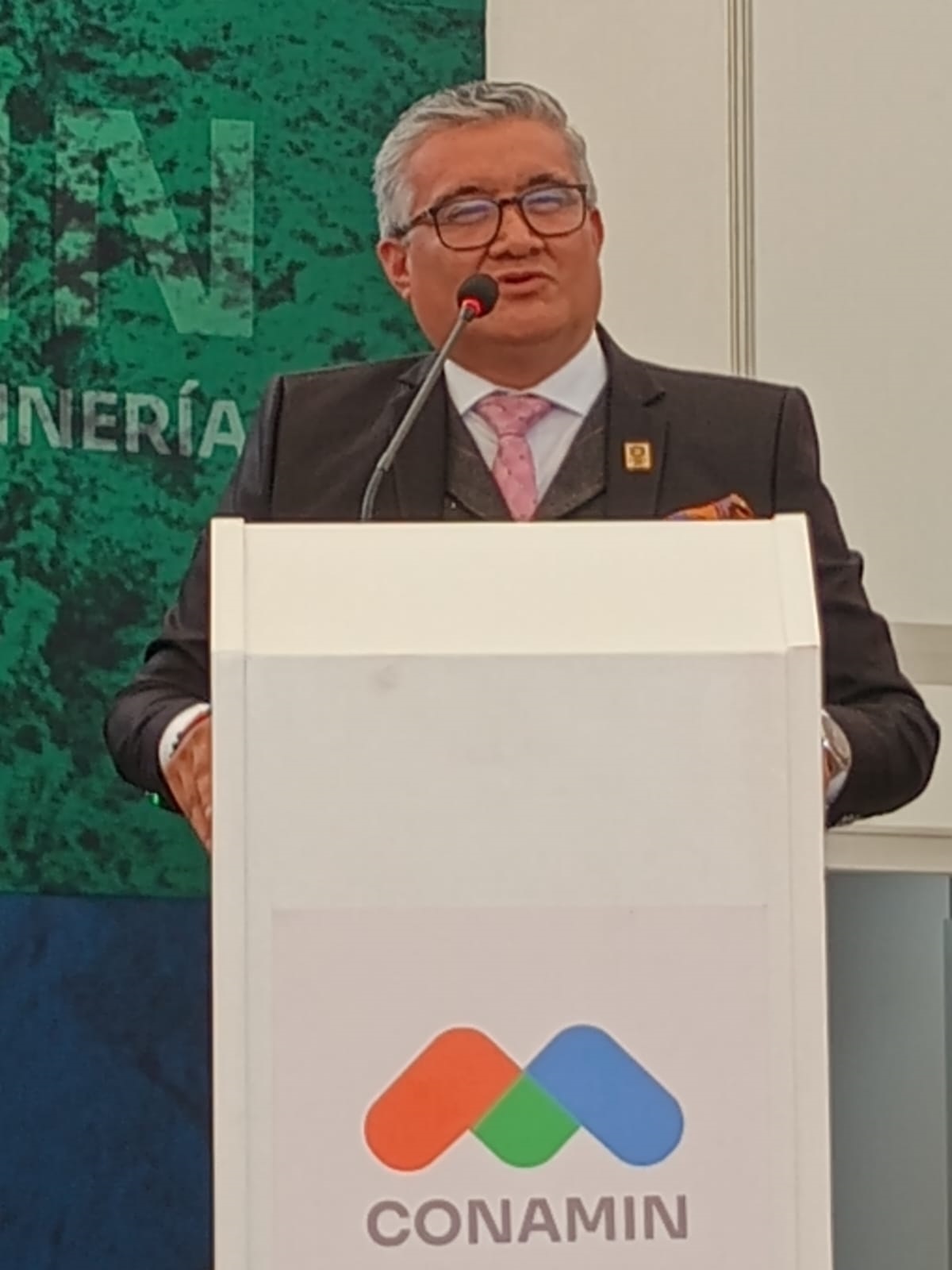 During his speech concluding the XV CONAMIN, the Minister of the Environment, Juan Carlos Castro Vargas, announced that “as an ambitious goal”, the reduction of bureaucratic procedures will be announced this July 28 by the President of the Republic.
Additionally, he announced a second goal for August: the unblocking of 32 mining projects totaling US$18 billion in investment, which are “awaiting approval” and are crucial for the job creation they project. “Simplification and streamlining of administrative procedures are essential to increase our competitiveness. Since we joined the Ministry of the Environment, we have always started by seeing that the country must be competitive,” said the Minister.
In this regard, he expressed hope that new regulations could soon be announced and that the Congress of the Republic would grant powers to the Executive to modify the environmental impact assessment system and the investment promotion law, “to further expedite projects and allow procedures to be completed in a single administrative act, thereby lifting our country.”
He highlighted the focus of the XV CONAMIN and the advances shown in innovation, digital mining, and the environment, “with decarbonization as a fundamental action against climate change. As a country, we have a fundamental challenge to achieve a 40% reduction in greenhouse gas emissions, and I also commend many companies that are now moving towards carbon neutrality, which I have had the opportunity to accompany in this process”.
Closing his speech, he reaffirmed his commitment “with the Ministry of the Environment and with the promotion of responsible and sustainable mining” and invited all involved parties to work together “because it is everyone’s task”. Finally, he congratulated the CONAMIN directors on the successful event, hoping that the XVI CONAMIN “will be even better.” Thus, he declared the event closed.
SNMPE: We are a country growing unevenly
 “Peru, unlike other countries in the region, has an investment grade, has managed to control inflation, and has a net debt ratio relative to the size of its economy among the lowest at 34%, and we are clearly here because mining is one of the pillars of the economy, representing more than 10% of GDP, nearly 60% of exports, and is also a significant contributor to public investment and taxation,” said Víctor Gobitz, CEO of Compañía Minera Antamina and President of the National Society of Mining, Petroleum and Energy (SNMPE).
But we have a small economy, barely representing 1.2% of the global economy with US$220 billion, and “that is why we must be aware that we need to have an export-oriented outlook,” the executive noted.
He also stressed that we must be aware of our challenges and mentioned:
“We are a country growing unevenly: A modern coastal area with access to global markets, higher population density, more public infrastructure, and greater state presence, compared to the high Andean regions where mining projects are generally located or the Amazon areas where there is great potential for hydrocarbon development. The informality of our economy: a scourge we must address. Public education and health do not meet international standards: if we do not address this issue, it is very unlikely that we will sustain being a developing country. And clearly, there is a cultural gap; I believe we all face daily the difficulty of lacking a public transport culture, for example”.
Meanwhile, “the Peruvian mining industry, over these 25 years, has managed to create a very mature ecosystem, with national and international companies (the world’s leading companies invest in Peru), with authorities, a very robust administrative system, institutions and organizations, academic training centers, analysts, journalists, engineering and consulting firms, suppliers with top-level technology, specialized contractors; we have significant infrastructure, although undoubtedly with a great challenge. It is no small feat to have this advantage already developed in the country… We have two major clusters: a large concentration of projects in northern Peru and another in the south, and in both, we must achieve associativity if we want them to be carried out with lower CAPEX and lower environmental footprints, where the portfolio of copper projects stands out, which must have an associative unit if we want to accelerate its development… that only requires willpower.”
He reaffirmed that we have a Mining Agenda today with three major issues:
Mining formalization,
A proposal that integrates territories, and…
Copper projects that must be seen as a catalyst for territorial development.
The effort of all depends on how to carry forward the agenda.